

From 1 November you are hearing about IndiGo flight cancellations all over India, but you don’t know why this is happening and whose fault it is — IndiGo or the DGCA. In today’s post, we are going to discuss in-depth about IndiGo flight cancellations across India.
Firstly, we will discuss the business model of IndiGo.
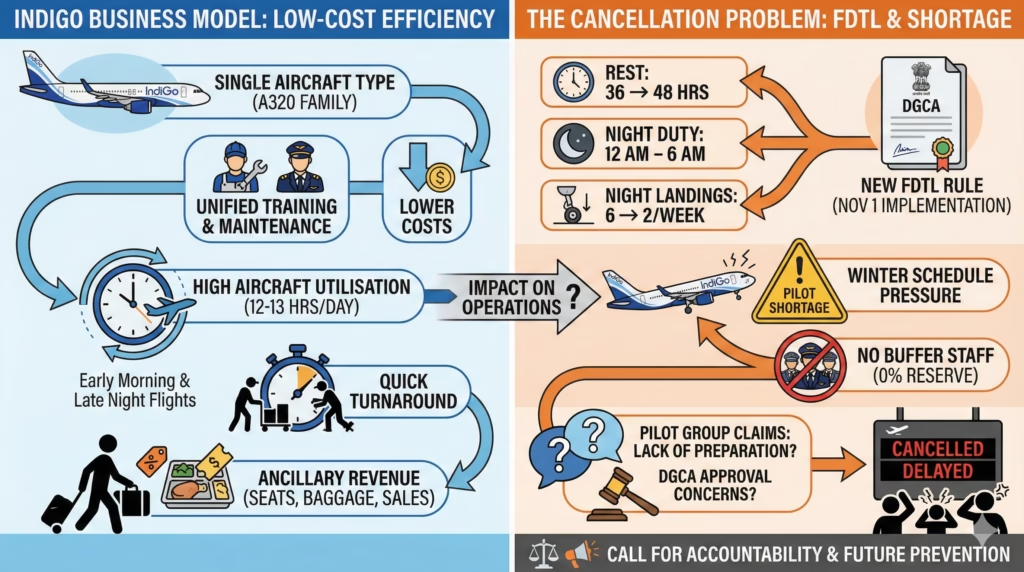
IndiGo follows a low-cost carrier (LCC) business model. They operate only one type of aircraft — the Airbus A320 family. Because of this, they don’t need separate pilot training for different aircraft, and they can use the same maintenance procedures and spare parts. This keeps both training and maintenance costs very low.
IndiGo also focuses on very high aircraft utilisation. While the global average is around 8–9 hours of flying per aircraft per day, IndiGo flies its aircraft for about 12–13 hours per day. They use early-morning and late-night flights to ensure the aircraft stays in the air as much as possible, because an aircraft earns money only when it is flying.
Another important part of IndiGo’s model is quick turnaround. They try to clean, unload, reload, and prepare the aircraft for the next flight in a very short time. This allows them to operate more flights with the same aircraft.
They also avoid providing free meals or expensive services, which helps keep ticket prices low. Instead, they earn extra money from seat selection, baggage fees, and onboard sales.
All of these factors — single aircraft type, low maintenance cost, high daily flying hours, night operations, and efficient turnaround — make IndiGo one of the most efficient and profitable airlines in India.
Why did the IndiGo cancellation problem happen?
The Directorate General of Civil Aviation (DGCA) introduced the latest FDTL rule from November 1, following the Delhi High Court mandate. In this rule, DGCA increased the rest hours of pilots from 36 hours to 48 hours, extended the night duty hours from 12 am to 6 am, and allowed only 2 night landings per week instead of 6 for each pilot.
DGCA implemented this rule on November 1. This is the second phase of the rule, and the first phase was implemented in July. This rule was proposed by DGCA 1 year ago. These norms were originally scheduled for March 2024 but, due to airline requests, a phased rollout was introduced (a phased rollout is a strategy for introducing a new product, system, or feature in small, manageable stages rather than all at once).
Why IndiGo is struggling
IndiGo Airlines, which operates around 2,300 domestic and international flights each day and handles 60% of the passenger traffic, is going through a pilot shortage compounded by winter schedule pressures. Because of that, they don’t have any buffer staff. Pilot groups are saying that IndiGo always maintains a 4% buffer workforce to tackle such worrisome situations, but in this situation they don’t have any buffer.
Pilot groups also say that because of this rule, most of the impact is going to fall on the airline. They also claimed that there are growing concerns that the flight delays and cancellations may be used to “arm-twist regulators” whenever rules do not suit the airlines. This point seems valid because the FDTL rule was proposed 1 year ago to all airlines, yet IndiGo did not take any action to prepare for this situation.
Despite this, the pilots allege that DGCA still approved the submitted winter schedule. They argue that DGCA granted approval based mainly on historical slot usage and the airline’s proposed plans, rather than verifying whether the airline had adequate pilot strength as required under the new duty-time and rest-time norms.
These concerns have been raised publicly by pilot associations, which have urged DGCA to approve seasonal schedules only after confirming that airlines actually have the manpower to operate the flights safely and reliably. However, the exact internal details — such as pilot roster strength, reserve availability, and DGCA’s evaluation criteria — are not publicly disclosed, so the full picture is not independently verifiable.
We can’t say directly whose mistake this is, but we have to take strict legal action against whoever is responsible so that this type of thing does not happen again.